Monday, 10 June 2013

Cost consultancy


Cost Consultancy for Designing and Building

As we can all understand, and most of us can experience, times at the moment are relatively tough.  Therefore knowing the price that a piece of design or building work may costs us is extremely important; especially for larger and commercial projects.


There are several different strands to our cost consultancy services.

The first is cost planning.  This aims to predict not only how much something will cost to build, but also once the quality is agreed, the lowest possible costing which will still allow the same goal to be met.  This will begin with initial discussions with you, the client, and will end up in the form of a market-tested cost plan.  Stakeholders will be encouraged to put their views forwards so that all sides of the party know what is necessary leading to a plan which provides a happy equilibrium for all.

The second, is cost control.  What we'll need you to make sure is in place first, is that expenditure and cash flow forecasts match available funding.  Cost control typically takes place at the latter stages of a project but it must also be mentioned or at least touched upon during the detailed design stages.  During building there will be many changes and unseen circumstances that must be overcome - cost control enables the correct action to be chosen.

Also offered, is procurement advice.  Hereby, all of the materials and necessary building tools will be researched in depth - a wide knowledge of worldwide building environments allows Saturn team members to source goods in the best possible way - whether it be for the lowest cost, or the most ethical route.

Lastly, we can offer a service named 'whole life costs'.  This concentrates on the long-term effects of a building upon wider costs such as heating.  Our aim here then is to create the most efficient and sufficient buildings at the best possible prices.  This stage an be undertaken at any stage of a project and is getting increasingly more important in the economic climate.


Wednesday, 29 May 2013

autoCAD


Auto Computer Aided Design

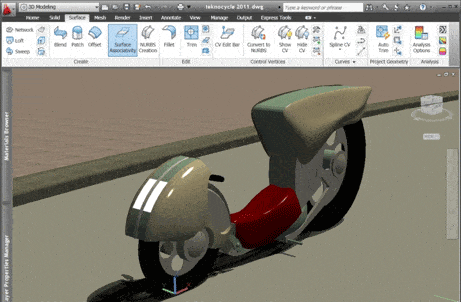
AutoCAD is a computer aided design program used for both 2D and 3D drafting.  Here at Saturn, autoCAD is used to make preliminary plans for building's designs.  When using the Architecture version of the program, the components will react intelligently to actions carried out, for example, the building of a wall may obstruct a window and thus the window would delete itself as it would become obsolete, making the program itself extremely capable.  There has just been the release of a new app by the Autodesk group: the AutoCAD 360 Pro, a line of easy-to-use web and mobile technologies which allow mobile drafting and documentation applications that allow users to view, create, edit and share drawings anytime, anywhere.
  

  An element of autoCAD which is currently attaining a great amount of media attention is the idea that 3D design products are now able, not only to provide the layouts for design, but new printing technologies means that they are also capable of printing the said design there and then.  For example, the start of May saw the world's first working 3D-printed gun shoot a bullet.  The creators, Defense Distributed, plan to make the blueprint readily available online, posing a viable threat internationally, as in the future not only Americans will easily be able to get their hands on fatal weapons, but the whole wide world.  Obviously this is worrying however many argue that criminals are much more likely to pursue traditional routes to obtain firearms.  


  AutoCAD then is obviously gaining momentum as the possibilities for design and printing open up tenfold alongside the developments of new technologies.  The future for programs such as autoCAD remains bright as design companies find its ease of use and uniformity across platforms highly advantageous.  What's more, the products created from this program are always of high quality.

Friday, 26 April 2013

Case Study (end of April)


Recent Case Study


Saturn Projects are proud to announce the opening of their latest attraction deep in the heart of Wales: The Silver Mountain Experience.  Situated in Aberystwyth, high in the Cambrian mountains, the park offers a quality visit not just for thrill-seekers alone; but also for those who just wish to enjoy the views of mountain springs, forests, and abandoned mine workings - which can be explored on walks (The Miners Trail) ; as well as there being a welcoming cafe area complete with wood-burning fire.  


The Black Chasm ride promises to make your nightmares become reality as an underground tour through the miners' tunnels is led by residents of the area: local gangs of wild Morgens, Orcs and the ugly eflin Welsh mine-dwellers, the Coblynaus'.  


The Woo Hoo Woods, on the other hand, allows a space in which children and big kids can let go - allow their imagination to take over and become Coblynaus's themselves, building dens from the trees, blocking the stream with dams and using the natural flow of the water to investigate the workings of the waterwheels.

The park is expected to entice over 30,000 visitors this year and reviews report the experience to be one to bring both fear and hilarity; in particular watch out for the explosion which creates 'it'!


All very mysterious and enticing, I know, so get yourselves down to The Silver Mountain Experience and scare yourselves silly whilst also becoming closer to the traditional tasks of the miners.


Tuesday, 9 April 2013

Herzog and de Meuron's Swimming Pool


Herzog and de Meuron's Swimming Pool, Riehen, Switzerland.

Work has finally started on Herzog and de Meuron's swimming pool, 34 years after they won a competition to design a municipal basin for the town of Riehen in Switzerland. 

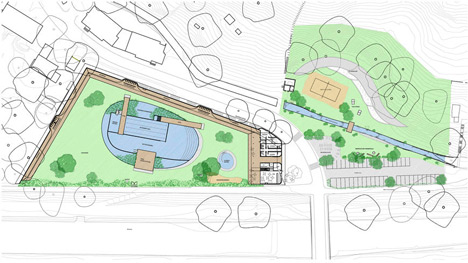
Naturbad Riehen's site plan.

They have decided to call the project 'Naturbad Riehen' and they are following guidelines which allow integration between the design, the manufacture, the current needs and the project's future growth.  The pool will be filled with natural water, without any chemicals, including chlorine.  Alongside providing an area large enough for 2000 bathers to pass through per day, Naturbad Riehen also incorporates a series of biological water treatment basins, positioned over the road in another field - making it an innovative and exciting piece of imagineering design.  
  The project was put to the side in 1982, however recent re-planning in 2007 allowed Herzog and de Meuron to come up with the idea to use natural filtration techniques in order to display ingenuity and adhere to current worldwide environmental and ethical concerns.  The duo proved their prominence in the world of design when, just last month, Herzog and de Meuron were among 12 international firms shortlisted to create a new headquarters for the Nobel prize in Stockholm, Sweden.  Construction has now began on the pool and it is forecast to be finished by 2014.

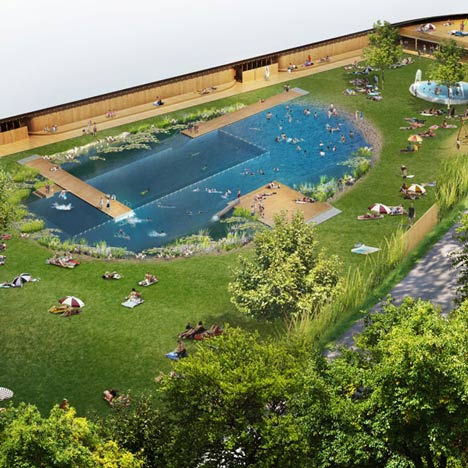
3D plan.

Wednesday, 3 April 2013

Milan Design Week


Milan Design Week: April

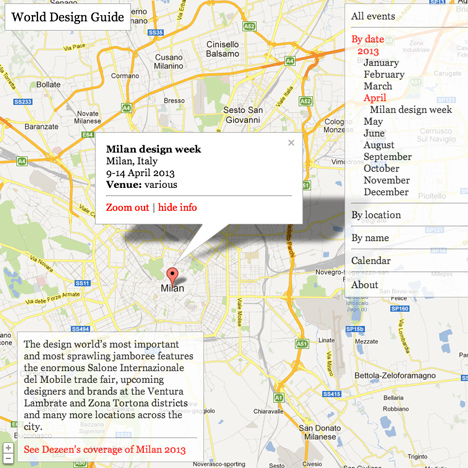
The spotlight for designers worldwide, this month, lies upon the city of Milan, in Italy.  Already known for its prestigious fashion accomplishments, the city is home to the 'Salone Internazionale del Mobile' trade fair for 5 days, from the 9th to the 14th of April.  Alongside the 5 day trade festival there promises to be many exhibitions, talks and of course, parties across the Italian capital for design.  

World Design Guide update: April

Check out some sneaky peaks at some of the pieces on offer in Milan this month: click here.

This event in Milan is just one of a number of occurrences taking place worldwide; take a look at the 'World Design Guide' to see where else you can have the chance to see such exhibitions... 

Or even, for the chance to add your event onto the guide email: hello@worlddesignguide.com.

Thursday, 21 March 2013

30 Storeys in 15 Days


In late 2011 Chinese architects of the Broad Group building company completed an incredible feat of engineering, proving to the world that they are not only leaders of manufacturing and computing but also of sustainable construction and indeed, renewable energy.


The Ark Hotel, in Changsha in the Hunan Province of China, took just 15 days to build: a mere 360 hours - thus keeping assembly costs to a minimum.  The project combined state of the art manufacturing techniques with efficient and eloquent design – areas in which the Chinese excel.  The majority of the structure was built off-site allowing workers to simply place the pieces into position, materials were prefabricated and the sections were built to specification; allowing for minimal waste.  Critics may question the durability of the building, however, the Broad Group is confident that the hotel will be 5 times more resistant to conventional builds, and will withstand earthquakes reading up to 9 on the richter scale.  The building is soundproofed, thermally-insulated and includes air quality monitoring systems – vital for modern-day China.  The project is deemed to ‘completely change the way that buildings are constructed’ and may even instigate the exportation of one of the last industries that China holds as its own: construction.

The time-lapse video below displays this remarkable accomplishment of the Broad Group, allowing its success to become an international phenomenon.


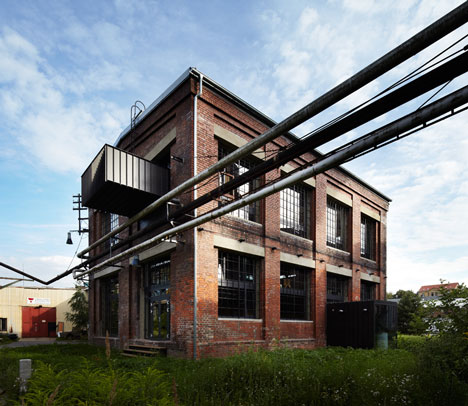
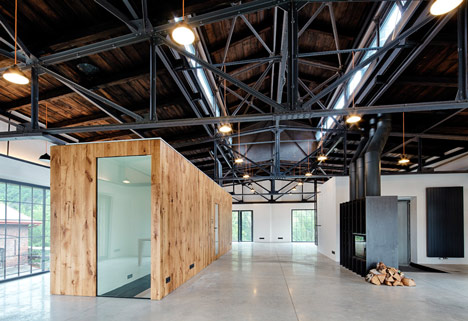
Coal Mill by Atelier Hoffman

Sustainable and environmentally-sound building techniques have been pushed to the limits by Czech architecture studio Atelier Hoffman in this build near Prague.


The three-storey building dates back to the beginning of the 20th century and has previously been used as warehouse space.  The architects have added steel volumes that extend out of the properties' perimeters, an outer stair case and entrance pavilion wrap around the corners, providing access both upstairs and downstairs.  Kitchens, bathrooms and storage facilities are contained within large wooden boxes.


Patrik Hoffman writes: "Renovation works were carried out between June 2010 and December 2011 following a plan and project by the architectonical studio Patrik Hoffman. In a join effort, the building of the old Coal Mine was transformed into an inspiring working environment and will continue to be used as a polyfunctional facility in which architecture, design, art, manufacture and warehousing meet each other."